
Dr. Alessandro Giardini
.png)
.png)
.png)

Most children with mitral valve prolapse are completely healthy and never need treatment. This page explains what MVP is, when it matters, and how Dr. Alessandro Giardini assesses and monitors the condition at his London clinics.
Mitral valve prolapse, also called MVP, is a relatively common condition where the mitral valve (the inlet valve to the left sided pumping chamber) does not work correctly. In this condition the two flaps of the mitral valve, called the leaflets, don't close smoothly or evenly. This is due to one or both of the leaflets of the mitral valve moving beyond the point where they should stop and bulging into the left atrium. While this happens, the 2 leaflets hitting each other cause a typical noise called a systolic click.
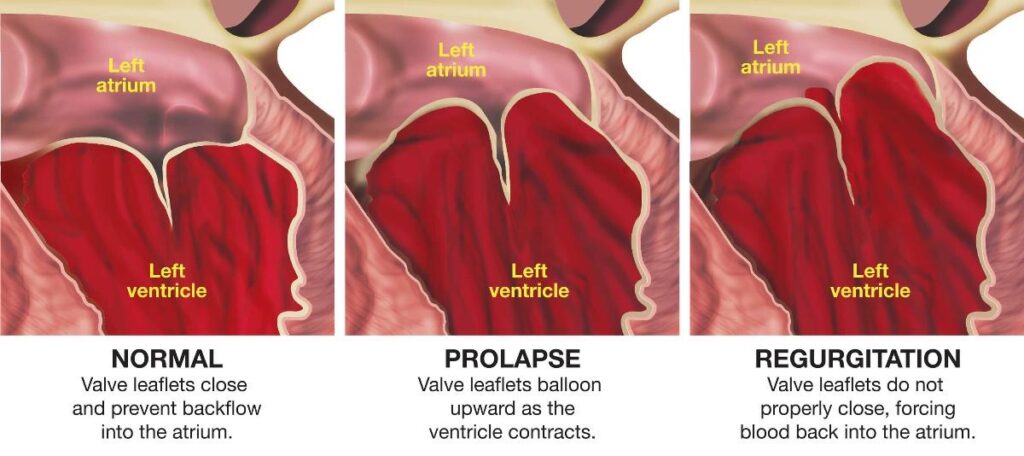
This condition is also known commonly as Barlow’s syndrome. In some children the bulge of the flap can be so pronounced that a back flow (regurgitation) can be seen. You can see a graphic view of a normal valve and a prolapsing valve in the image below.
The function of the mitral valve is to close when the heart is pumping, avoiding any back flow of blood into the left atrium and the lungs. In this condition, when the left side of the heart contracts (pumps), part of one or both leaflets collapses backward into the left atrium.
This is often due to the mitral valve leaflets being too large and thick or the supporting strings are too stretchy. In some cases, a small gap can develop between the 2 leaflets and this can cause some blood to flow back. This back flow is called regurgitation or leakage and can cause a heart murmur.
It occurs in around 1-2% of the population so it fairly common. This condition affects boys as much as girls.
It can occur in children and adolescents as well as in adults. This condition is unusual in newborn and very small children and becomes more common during childhood and adolescence. The cause of that is not known but it is clearly related to the development of the heart.
It is caused by is abnormally stretchy (or myxomatous in medical jargon) mitral valve leaflets. It can have a genetic cause. There are many syndromes where it is very common. In these condition usually the connective tissue is affected: Marfan syndrome, Ehlers-Danlos syndrome, Loeys-Dietz syndrome, etc.
Besides the forms of MVP associated with syndromes, it can occur in families, where multiple generations and people can be affected. MVP is associated with chest wall deformities like pectus excavatum and pectus carinatum, scoliosis and hypermobile joints.
It can also be seen in children who have a history of rheumatic fever.
The majority of people with this condition do not have cardiac symptoms. As a result, the diagnosis is usually the result of a referral for a systolic click or a heart murmur which is heard during a general clinical consultation. Sometimes the diagnosis of MVP is made during the cardiology assessment of children with suspected Marfan or Ehlers-Danlos Syndrome, connective tissue diseases or chest wall deformities. Once a diagnosis is suspected, the child needs to be reviewed by a paediatric cardiologist who will undertake an echocardiogram to confirm the diagnosis.
It may not affect the body directly if the valve is perfectly competent and has no leakage. If the valve has a significant leakage then this can cause the left side of the heart to swell progressively and can cause children and adolescents to start complaining of easy tiredness and breathlessness. Additionally mitral valves with prolapse and regurgitations are at higher risk of getting infected, causing infective endocarditis.
Parents often ask whether children with mitral valve prolapse need antibiotics before dental procedures. Current NICE guidance does not recommend routine antibiotic prophylaxis for MVP, even when mild regurgitation is present. Dr. Giardini provides individualised advice on this during the consultation.
In most children, mitral valve prolapse is a harmless finding that has no impact on health or activity. The large majority of children never develop symptoms and do not require any treatment. The important question is whether the prolapse is causing any leakage of the valve, a condition known as mitral regurgitation. It is the degree of regurgitation, rather than the prolapse itself, that determines whether periodic monitoring is sufficient or whether closer follow-up and, in rare cases, treatment may be needed. Dr Giardini can assess this with an echocardiogram during a single appointment and provide you with a clear answer. However, up to 10% of people with MVP and progressive regurgitation may require treatment and this is usually represented by surgery to repair (and sometimes replace) the mitral valve. Medications may also be used at times to help the heart the heart to deal with the regurgitation and to delay surgery.
Because most patients with MVP do not have symptoms, a heart murmur detected during a routine physical exam when listening to the heart with a stethoscope may be the only sign. Common symptoms described by children and adolescents with mitral valve prolapse include include:
Children with associated mitral valve regurgitation can also describe breathlessness as a symptom. Significant amounts of mitral valve regurgitation can ultimately cause the heart to enlarge and subsequently to fail if left untreated. Valves with MVP are also at slightly higher risk of getting infected, a condition known as infective endocarditis.
Even for those children and adolescents who do not have symptoms, an echocardiogram is usually recommended if they have a murmur detected which is suggestive of MVP.
The echocardiogram is able to confirm the diagnosis of MVP and also to identify the extent of prolapse and to quantify the extent of any mitral valve leakage (regurgitation). In some children a Holter ECG monitor or a cardiac MRI might be required.
Most children with mitral valve prolapse remain completely well and lead normal, active lives. However, specialist assessment becomes more important if your child develops symptoms such as increasing breathlessness, reduced exercise tolerance, frequent palpitations or significant fatigue. In a small number of cases, the valve leakage can progress gradually over time, leading to enlargement of the left side of the heart. This is why Dr Giardini recommends periodic review with echocardiography even when symptoms are mild or absent, so that any change can be detected early and managed appropriately before it becomes a problem.
Most children in this group need little or no follow-up and live completely normal lives.
These features are usually not dangerous, but they are a reason to review the valve and ensure it is not changing over time.
These are uncommon, but may indicate that the valve is leaking more significantly and needs closer monitoring or treatment.
Although mitral valve prolapse is usually benign, the important question is not simply whether it is present, but whether it is affecting the way the valve works. A specialist assessment can resolve this clearly during a single appointment. Dr Giardini performs and interprets all echocardiograms personally, providing a detailed picture of the valve structure, the degree of any leakage, and the impact on the heart. In the large majority of cases, families leave the consultation with a definitive answer and the reassurance that no treatment is needed.
For many people mitral valve prolapse is a finding on the echocardiogram which requires periodic follow up but no treatment and no change in lifestyle. People with MVP and regurgitation may require treatment in they are getting symptoms like breathlessness or very easy fatigue, if the mitral valve regurgitation is becoming more severe, if the left atrium and the left ventricle are becoming progressively more enlarged, if the pumping function of the the left side of the heart starts dropping or if children and adolescents develop arrhythmia or palpitations. Arrhythmias and palpitations are more common in children and adolescents with mitral valve prolapse as the regurgitation from the valve can cause the heart to enlarge and this may trigger problems with the heart rhythm.
Most children and adolescents with this condition do not require treatment. Those with severe or increasing mitral valve regurgitation or with symptoms may require treatment. Whenever possible treatment consists in the repair of the mitral valve to make the regurgitation disappear or reduce. In some instances, when the tissue of the valve is not of good quality or when the valve is significantly damaged then the whole valve may need to be replaced, most commonly with a mechanical valve but other alternatives are available in younger children.
Is mitral valve prolapse common in children?
Yes, it is relatively common. Many children are found to have mild mitral valve prolapse incidentally during an echocardiogram, and in most cases it has no clinical significance.
Can mitral valve prolapse go away as a child grows?
In some children, particularly those with very mild findings, the appearance of prolapse can become less noticeable over time as the heart grows. However, in others it may persist into adulthood without causing any problems.
Does mitral valve prolapse cause chest pain in children?
It can, but the chest pain is usually not dangerous and is not related to reduced blood flow to the heart. It is often brief, sharp, and not triggered by exercise. A specialist assessment can confirm whether the pain is related to the valve or something else.
Are palpitations common with mitral valve prolapse?
Some children and teenagers with mitral valve prolapse report palpitations. These are usually benign, but if they are frequent, prolonged, or associated with dizziness, further assessment such as an ECG or Holter monitor may be recommended.
Does my child need regular follow-up?
This depends on whether there is any valve leakage. If the valve is functioning normally, follow-up may be minimal or not needed. If there is mitral regurgitation, periodic echocardiograms are used to monitor the valve over time.
Can mitral valve prolapse get worse?
In most children, it remains stable and does not progress. A small proportion may develop increasing valve leakage over time, which is why follow-up is advised when regurgitation is present.
Can my child play sport with mitral valve prolapse?
Yes, in the vast majority of cases. Children with mild mitral valve prolapse and no significant valve leakage can participate fully in sport and physical activity. Advice is individualised if there are additional findings.
Does mitral valve prolapse require surgery?
Surgery is very rarely needed in children. It is only considered in the uncommon situation where there is severe valve leakage affecting heart function. Most children with mitral valve prolapse never require any intervention.
Author: Dr. Alessandro Giardini, MD, PhD
Written 03/04/2026